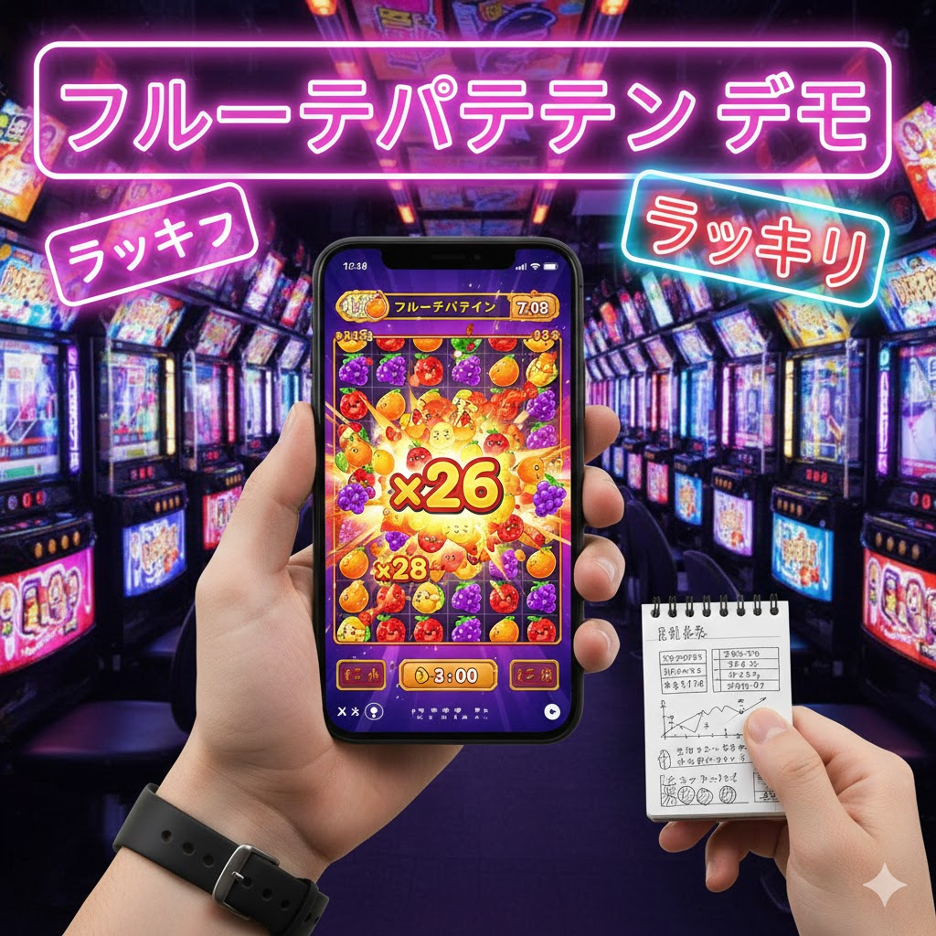
The first thing that strikes you about Fruit Party is the aesthetic. It looks like a high-end mobile puzzle game, something you’d play on the Yamanote line to kill time. Bright strawberries, oranges, and grapes tumble onto the screen with a satisfying “pop.”
But in Japan, the most successful games often use this visual disarming technique. It’s a paradox: the game looks like a children’s candy store, but its math model is a “Gekikara” (super spicy) high-volatility monster.
“The Japanese market has a unique psychological relationship with ‘cute’ aesthetics masking high-risk mechanics. We see this in the transition from traditional Pachislot to digital games like Fruit Party. The visual simplicity provides a sense of comfort and approachability, which paradoxically allows the player to tolerate the high volatility of the 5,000x max win potential. It’s a sophisticated play on user trust.”
- Megumi Kato, Lead Analyst at Gijima Media.
Why Japan specifically? The Pachislot Connection
To understand Fruit Party’s success, you have to understand the Pachislot culture. Japanese gamblers are used to “Renchan”, a feature where bonuses or wins continue in a streak. Fruit Party’s “Tumble” (or cascading) mechanic feels like a digital evolution of this. When a cluster of five or more fruits explodes and new ones drop in, it triggers that same dopamine loop.
Moreover, the random multipliers, which can stack up to a staggering 256x, mimic the “Stock” and “Tenjo” systems in Japanese parlors where the next big win always feels like it’s just one spin away.
Why Everyone is Searching for the “Demo”
If you look at search trends in Japan, “Fruit Party Demo” (フルーツパーティー デモ) often outpaces the real-money search terms. This isn’t just because people want to play for free; it’s about strategy.
In a market where the “take-out rate” and RTP (Return to Player) are discussed with the intensity of stock market trends, the demo is a laboratory.
“In Japan, the ‘demo’ is more than a trial; it’s a data collection phase. Japanese players are notoriously detail-oriented. They use the demo to test the frequency of the ‘Golden Fruit’ scatter and to map out the volatility of the multiplier clusters. They want to see the ‘face’ of the machine before they commit a single yen. At Gijima Media, we’ve tracked a direct correlation between demo engagement and long-term player retention in the Asia-Pacific region.”
– Shota Yamashita, Strategic Consultant at Gijima Media.
The “Cluster Pay” Revolution
Most traditional slots rely on paylines, straight or zig-zagged lines across the reels. Fruit Party threw that out for Cluster Pays. In a culture that grew up on Puyo Puyo and Tetris, the idea of connecting blocks of symbols is second nature.
It feels less like a “gambling machine” and more like a “game” where you have a degree of influence. While the outcome is still governed by a Random Number Generator (RNG), the visual feedback of a large cluster feels more earned than a simple line-up on a traditional reel.
Localization and the Bulgarian Bridge
It might seem strange that a marketing agency originating from Bulgaria, Gijima Media, is at the forefront of analyzing this Japanese trend. But as the digital world flattens, the “Bulgarian perspective” offers a unique bridge between European developers (like Pragmatic Play) and Asian markets.
“Localization is no longer just about translating text into Japanese; it’s about ‘math-alization.’ You have to align the game’s volatility and hit frequency with local expectations. Fruit Party hit the sweet spot because its ‘Tumble’ frequency mirrors the pacing of a modern Japanese arcade game. Our role is to help developers understand that a Japanese player’s ‘luck’ is often seen through the lens of persistence and pattern recognition.”
– Kana Makita, Market Localization Specialist at Gijima Media.
Summary of Fruit Party’s Japanese Popularity
| Feature | Why it Works in Japan |
| 7×7 Grid | Familiar to fans of mobile puzzle games. |
| Max Win (5000x) | High “dream potential” for serious bettors. |
| 256x Multipliers | Random “surprises” that break the monotony. |
| No Wild Symbols | Simplifies the gameplay, focusing purely on clusters. |
Final Thoughts: Is it Just a Phase?
Fruit Party Demo isn’t a flash in the pan. It has spawned sequels (Fruit Party 2) and countless clones, but the original remains the gold standard in Japan. Its popularity tells us a lot about the modern Japanese gambler: they want something that looks inviting, plays fast, and offers the potential for a life-changing “hit” without the complexity of modern video slots.
The surge in “Demo” searches is a sign of a maturing market. Players are getting smarter, more cautious, and more analytical. They aren’t just looking for a party; they’re looking for a winning strategy.