Most directors receive a monthly financial report. Fewer can give you the answer. A Profit and Loss statement will tell you what happened but won’t usually explain why or what should happen next.
This is where many developing SMEs begin to look at outsourcing CFO support. A well constructed reporting pack will help answer these questions. In this guide we’ll look at what to include, which KPIs are important and how to interpret them.
What Is a Monthly CFO Reporting Pack?
It’s a short report that combines your financial results with analysis, forecasts, risks and recommended actions. Directors use it to steer the business, not just to file it.
It overlaps with other documents but does a different job:
|
Document |
Purpose |
|
Bookkeeping records |
Day-to-day transactions |
|
Statutory accounts |
Annual legal reporting |
|
Management accounts |
Monthly performance figures |
|
CFO reporting pack |
Figures plus analysis, forecasts and advice |
|
Board pack |
Wider meeting papers, including non-financial items |
Monthly reporting matters because problems grow quietly. A slipping margin or slow-paying customer costs far less to fix in month two than in month nine.
What Should the Pack Include?
While the format will be dependent on your organisation and industry, most good packs have these 7 sections:
1. Executive Summary: This is 1 page of high level info. It shows revenue, profitability, cash, any significant changes to the budget, risks and decisions the board needs to know about. Don’t list every number, just explain what has changed.
2. P&L: Shows the revenue, cost of sales, gross profit and margin, overheads, EBITDA (earnings before interest, tax, depreciation and amortisation) and profit. Compare the budget, previous month and previous year. You’ll want to see how your margins and costs are doing.
3. Balance Sheet & Working Capital: This shows what is affecting your cash position. Are you on receivables (money owed), stock or payables? If you know what your working capital looks like then you’ll know if you can meet your short term obligations.
4. Cashflow & Forecast: This section should cover your cash. Opening balance, closing balance, tax and loan payments, planned expenditure. If it fits with your business, include a 13 week rolling forecast.
5. KPI Dashboard: This will depend on your business model. Rarely will someone else’s dashboard work.
6. Variance Analysis: This is comparing your actuals to your original budget and latest forecast. The budget will show you how you’re performing against the plan. The forecast will show you what you expect going forward.
7. Risk, Opportunity & Action Log: For every significant issue you should have an action, owner and deadline.
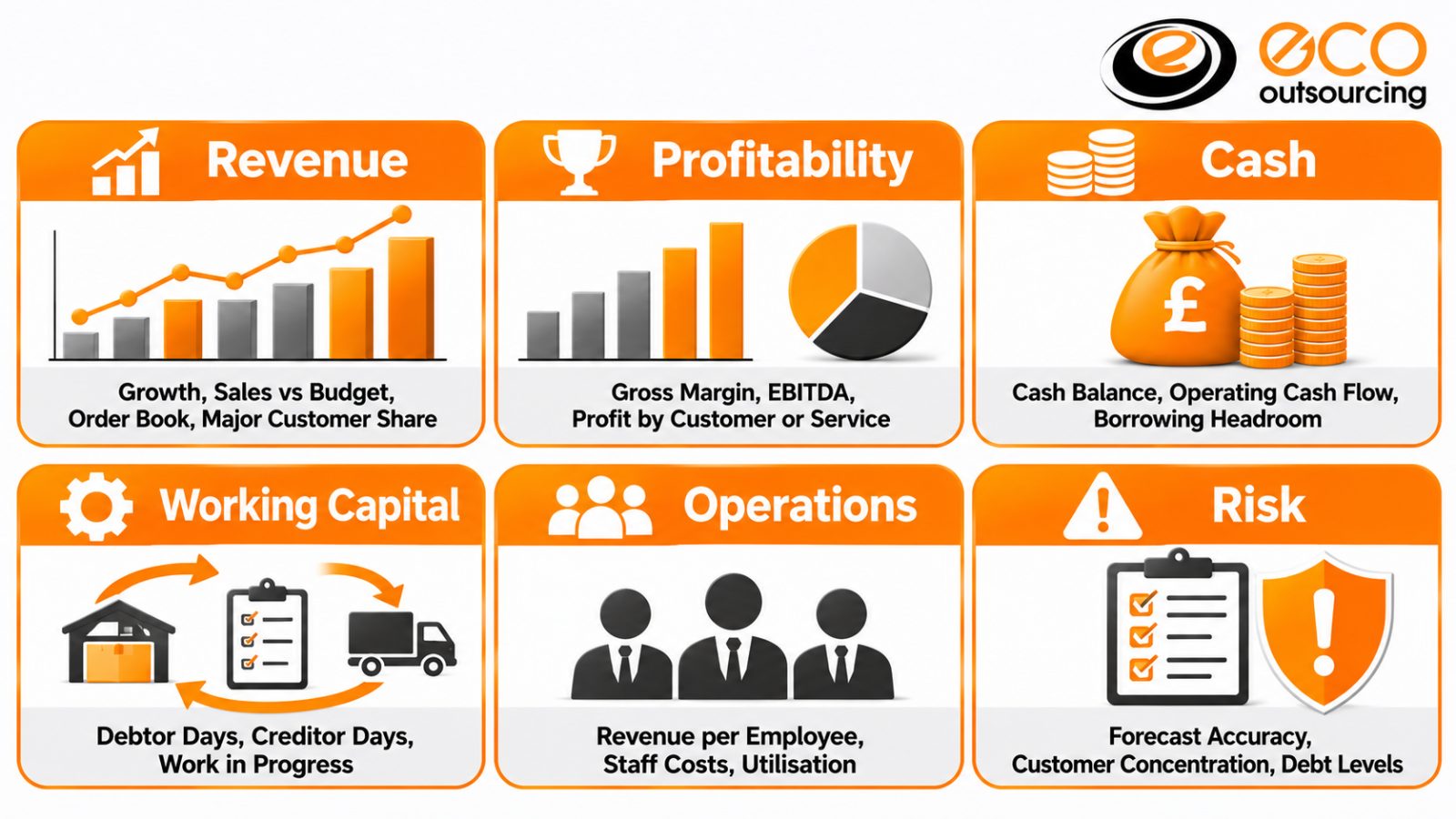
Which KPIs Should the Board Review Monthly?
Not every business needs every measure. Focus on the financial KPIs that drive decisions.
|
Area |
Useful KPIs |
|
Revenue |
Growth, sales against budget, order book, share from major customers |
|
Profitability |
Gross margin, EBITDA margin, overhead ratio, profit by customer or service |
|
Cash |
Cash balance, operating cash flow, forecast, borrowing headroom |
|
Working capital |
Debtor days, creditor days, aged receivables, work in progress |
|
Operations |
Revenue per employee, staff costs as a share of revenue, utilisation |
|
Risk |
Forecast accuracy, customer concentration, debt levels |
Industry changes the mix. A consultancy watches utilisation and unbilled work. A retailer tracks stock turnover and returns. A SaaS firm follows recurring revenue and churn. A contractor focuses on work in progress and retention.
How Do You Read the Numbers?
Numbers only help if you ask the right follow-up questions. For each change, ask what moved, why, whether it matters and what to investigate.
Revenue is up but margin is falling. Supplier costs, discounting or unprofitable projects could be eating the gains. Growth that loses money isn’t growth.
You’re profitable but cash is dropping. Late payers, stock purchases, unbilled work, tax bills or equipment spending can all drain cash while profit looks healthy.
Debtor days are rising. Customers are paying slower, which squeezes working capital. Review overdue invoices, disputes and your chasing process.
You keep missing forecasts. Repeated misses point to weak sales visibility, optimistic assumptions or poor cost control.
One customer dominates revenue. If they leave or pay late, the whole business feels it.
Before the Pack Reaches the Board
A realistic time frame needs to be agreed. There is no legal requirement for the pack to be done by a certain date, however to ensure that your pack is of high quality, you should always follow a consistent monthly process:
- Close off the period and bank reconciliation.
- Reconcile customer and supplier balances.
- Record accruals/prepayments, check payroll and expenses.
- Ensure revenue and costs are cut off correctly.
- Prepare statements, analyse key performance indicators and variances.
- Update the cash forecast and review/approve.
Mistakes That Weaken a Reporting Pack
- Too many KPIs. They bury the few that matter.
- Only revenue and profit. Cash and the balance sheet tell the rest of the story.
- No forecast. History can’t show your future position.
- Figures without commentary. Explain causes and impact.
- Unreliable data. Unreconciled accounts, missing accruals and inconsistent KPI definitions undermine everything.
- No owners. Every issue needs an action, a person and a date.
When Should You Consider Outsourced CFO Support?
Bookkeeping will keep a record of your previous transactions and a CFO will provide interpretation and planning based on that data. If your business has progressed beyond simple bookkeeping and you can’t easily predict your cash flow, or your reports aren’t providing clarity, you may benefit from outsourcing CFO requirements.
It can also help businesses who want to have high level financial management without employing a full time finance director.
This doesn’t replace your accountants. An outsourced CFO can complement your accountants or bookkeepers.
Frequently Asked Questions
What is the difference between a CFO report and management accounts?
Management accounts give an overview of your finances whilst the CFO report will add analysis, planning, risk assessment and recommendations to help directors make decisions.
How many KPIs should be included in the board pack?
There’s no set answer but keep it simple and choose some meaningful metrics. If no one is acting on the KPI then remove it.
Should we include a cash flow forecast?
Yes. The forecast will help directors understand how much cash they will have going forwards.
Why would a profitable company have a cash flow problem?
Profit and cash are two separate things. You may have late receivables, stock, work in progress, tax liabilities and capital expenditure which is tying up your cash.
Do I need an outsourced CFO for my small business?
Not necessarily. If you need more planning, insight and strategic help then an outsourced CFO can help.
Conclusion
This will give you a greater understanding of key finance terms like cash, margin, working capital and risk. KPI’s will vary depending on your size, industry and objectives so take a look at the reports you currently have and see if they provide you with enough information to make a decision.
If not, outsourcing CFO function is the best place to start.
Eco Outsourcing’s outsourced CFO services are worth exploring, and it’s sensible to ask exactly what’s included before you commit.