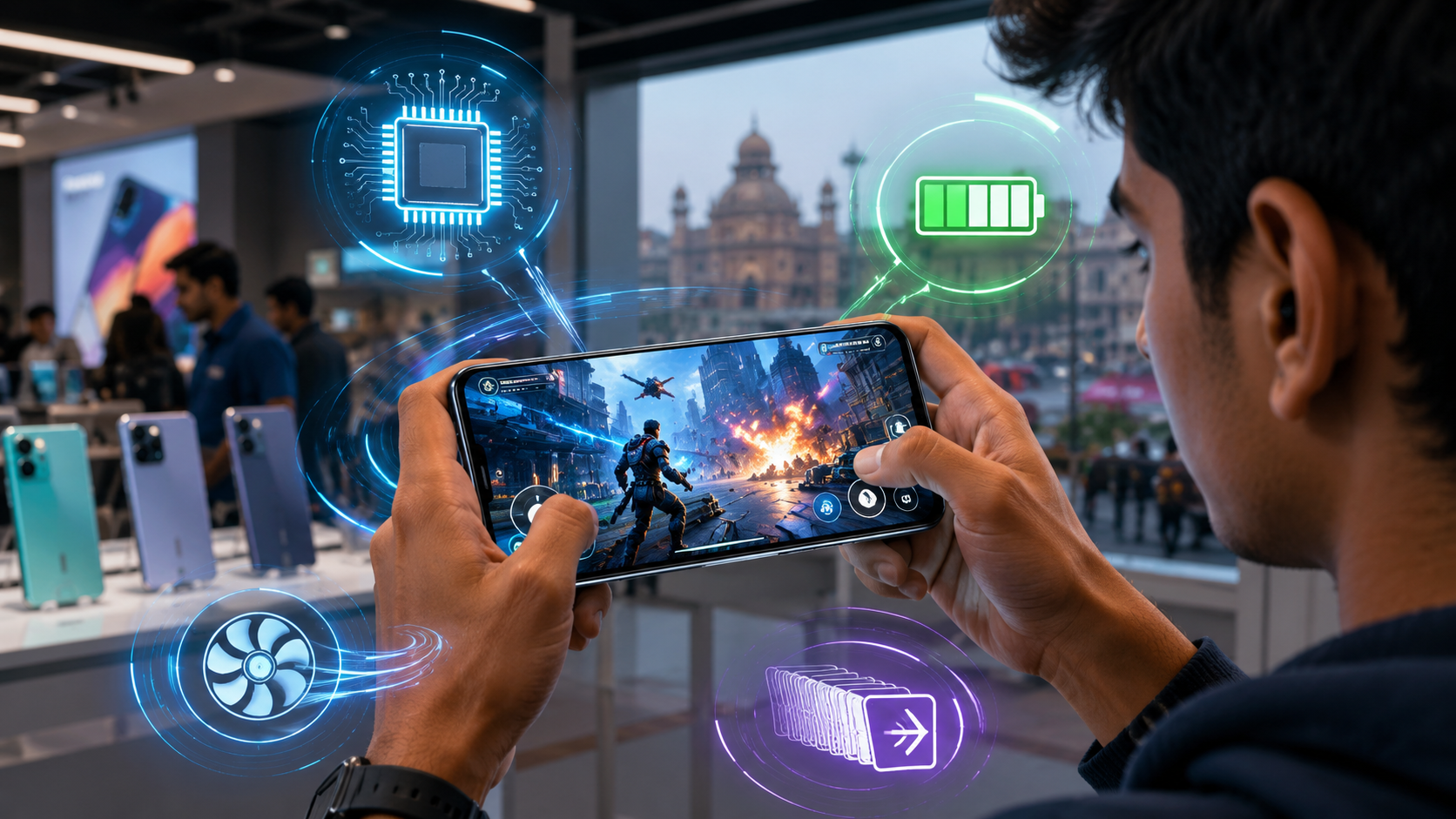
India has been playing mainly on mobile for years, but the most interesting shift is no longer just about the number of users downloading titles such as BGMI, Free Fire MAX or Call of Duty Mobile. It is about the influence those habits are beginning to have on the device market. Buyers are paying closer attention to the processor, battery, cooling and screen speed, features that not long ago seemed reserved for specialised models and now appear across much of the mid-range segment.
The broader context helps explain this transformation. India has around 555 million gamers, and its video game market exceeded 1.5 billion dollars during the most recently analysed financial year. Mobile remains the most accessible gateway to all kinds of digital entertainment, from the most demanding action titles to modern online casino slots, so brands can no longer design phones with only the camera or social media in mind. For millions of consumers, the device also has to keep a game stable, respond quickly and last for hours away from the charger.
The processor is no longer buried in the fine print
For a long time, phone marketing campaigns in India placed megapixels and design at the centre of the showcase, while the processor stayed hidden among specifications that few buyers seemed interested in understanding. That stage is coming to an end. A consumer survey conducted by Counterpoint found that 28% of respondents considered the processor especially important to overall performance, ahead of factors such as battery life, 5G and the camera.
The same study showed that 84% of respondents understood the role of the chipset, which suggests that Indian consumers have developed a much deeper technological awareness. Gaming has a great deal to do with that shift, because a user may not notice major differences while sending messages or scrolling through social media, but they notice them very quickly when frame drops, overheating, long loading times or unexpected crashes appear during a competitive match.
Battery life and cooling are becoming decisive
A phone can achieve an impressive benchmark score and still offer a poor experience after twenty minutes of gaming, when heat forces the system to reduce performance. That is why consumers are starting to focus on sustained performance rather than just the peak speed advertised by the brand, while vapour chambers, bypass charging and thermal control systems are taking up more and more space in product launches.
Battery life is just as important in a market where the smartphone concentrates work, communication, payments, video and entertainment in one device. Between January and May 2025, the average battery capacity in phones sold in India reached 5,212 mAh, while in the segment below 20,000 rupees, battery life became the most valued specification among surveyed consumers. Players do not want to choose between finishing a session and keeping enough charge for the rest of the day.
Manufacturers are responding with numbers that would have seemed excessive not long ago. The iQOO Neo 10R combines a 6,400 mAh battery with a 6,043 square millimetre vapour chamber, while the OnePlus Nord 6 advertises 9,000 mAh, bypass charging and up to 11.1 hours of BGMI under the company’s own testing conditions. These are marketing figures that should be treated with caution, but they show very clearly which features are now being used to convince Indian buyers.
Fast displays are no longer a luxury
Refresh rate has become another common selling point, although here it is important to separate real usefulness from marketing. A 120, 144 or 165 Hz display can offer smoother scrolling and a more pleasant visual response, but the game, processor and software must be able to generate enough frames to make use of it. Having a 165 Hz panel does not guarantee that every title will run at 165 frames per second.
Even so, the direction of the market is clear. The iQOO Neo 10R offers a 144 Hz AMOLED panel and specifies that the maximum refresh rate works in compatible scenarios, while the OnePlus 15R combines a 165 Hz display with modes of up to 120 frames per second in certain games. Brands themselves include those limits in the small print, a necessary clarification to stop buyers from confusing the panel’s capability with the actual performance of every title.
Touch response is also becoming more important, especially in shooters and competitive games where fractions of a second can change the sense of control. The Redmi Turbo 5, for example, advertises an instant touch response of up to 2,560 Hz in specific situations, along with dedicated cooling and a 7,540 mAh battery.
Gaming is transforming even conventional smartphones
So-called gaming phones remain a relatively specialised category, with aggressive designs, physical triggers and cooling accessories that do not appeal to everyone. The real influence of the sector can be seen in conventional models, where elements once associated exclusively with gaming devices are now becoming standard.
A buyer may choose a phone for its battery life, screen or smoothness without considering themselves a gamer, even though many of those improvements arrived because of gaming demands. Vapour chambers also help during video recording, large batteries improve any intensive day of use, and powerful processors make it easier to use artificial intelligence tools, edit content or keep a device for more years.
Indian gamers are already shaping the next smartphone
Gaming has not replaced the camera as the main purchase driver, but it now shares space with it and forces manufacturers to pay attention to features that could previously go unnoticed. Processor, battery, display, cooling and storage are now part of a much more mature conversation, especially among younger users who rely on the same device to compete, create content and connect with their community.
There is little doubt that this influence will continue to grow, because India combines a huge audience, a highly competitive mobile industry and increasingly well-informed consumers. The next big market success may not have RGB lights, physical triggers or the gaming phone label, but it will have been designed with people in mind who want to play for hours without losing performance.